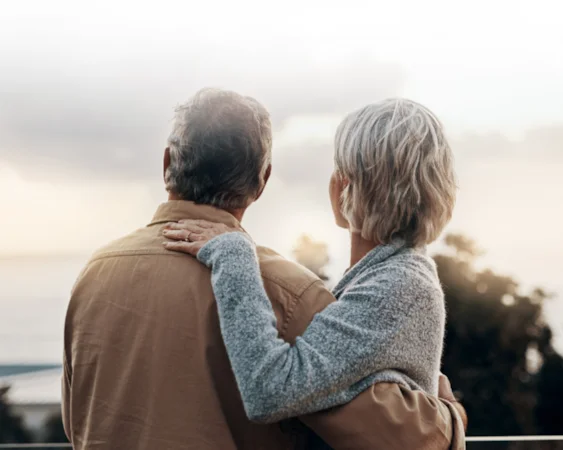

Quick summary
The fear that meeting someone new means forgetting your late partner is one of the most common concerns widowed people have — and one of the least founded. The capacity for connection does not diminish with loss, and a specialist over-60s site gives you the best environment to meet people who understand your situation without needing it explained.
Losing a spouse is unlike any other loss. The person who shared your daily life — who knew your habits, your history, your private jokes — is gone, and the shape of everything changes. The house feels different. Time feels different. Even the small, ordinary moments that used to be unremarkable — a meal, an evening, waking up on a Sunday morning — carry a weight they never had before.
Thinking about dating again after this kind of loss takes courage. Not because it is wrong, or too soon, or disloyal — but because it means choosing to be vulnerable again, to try again, when you know exactly how much it hurts to lose someone you love.
This article is for anyone who is at that point of wondering. Whether you are actively looking, cautiously curious, or simply trying to understand what you are feeling, we hope it offers something useful.
Why people hesitate — and why the hesitation makes sense
The most common thing people say when they consider dating after losing a spouse is some version of: “I feel like I would be replacing them.” This fear is understandable, but it rests on a misunderstanding of what love actually is.
No one can be replaced. The person you lost was irreplaceable — not because nobody else is worthy, but because what you had with them was specific to you, to them, and to the years you shared. A new relationship would not be that relationship. It would be something entirely different, shaped by entirely different people in a different time of life. It would not cancel what came before. Nothing can.
What a new relationship can be is something valuable in its own right: connection, companionship, laughter, warmth, someone to talk to and go places with and share the ordinary stuff of daily life. These are not lesser things just because they are different.
How grief and dating can coexist
One of the myths around dating after loss is that you need to have fully processed your grief before you can begin. In practice, grief rarely works that way — it does not have a finish line. Most people who date after losing a spouse do so while still grieving, not after grief has ended.
What tends to shift over time is not that the grief disappears, but that it becomes something you carry rather than something that carries you. There are more days when you can think about your spouse with warmth and sadness rather than acute pain. More moments when the future seems possible rather than formless. That shift — not the end of grief — is what makes dating feel workable.
Being honest about where you are, including with people you meet, matters here. You do not have to present yourself as fully healed. You do not have to pretend that your spouse did not exist or that their absence does not still sometimes ache. The right person will understand this, because most people at this stage of life have their own version of it.
Many people find that talking to others who have been through the same experience is one of the most genuinely helpful things they can do. Over-60s dating communities often include members who are widowed and who understand the particular emotions involved without needing them explained.
The practical questions
Most people approaching dating after loss have a handful of specific, practical concerns. Here are the most common ones, answered honestly.
When should I start? When you feel genuinely open to meeting someone, however tentatively. Not when other people think you should, or when a certain amount of time has passed. Curiosity is a good enough reason to begin.
What do I say about my late spouse? You do not need to hide them or pretend they did not exist. A brief, natural mention is usually the right approach early on — enough to be honest without making it the defining subject of every conversation. As you get to know someone, deeper sharing becomes natural.
How do I handle the comparison? You will almost certainly compare people you meet to your spouse — consciously or not. This is natural. The question to sit with is not “is this person as good as them?” but “is this person someone I genuinely enjoy spending time with?” No one will be identical to the person you lost, and no one should have to be.
What if I feel guilty? Almost everyone does. It does not mean you are doing something wrong. It usually means you loved deeply. The guilt tends to lessen over time, particularly when the relationship you are building feels respectful of your past rather than in conflict with it.
What you bring to a new relationship
Something worth recognising: after years of a serious relationship, you are not starting from scratch. You know what a real partnership looks and feels like. You know what it means to be genuinely known by someone, and to genuinely know them. You have a clarity about what matters — not just in a partner, but in life — that most younger people are still finding.
That is not a small thing. It is, in many ways, a gift you bring to any new connection. The patience, the perspective, the lack of pretence about what you want — these make you, in many respects, a far better partner than you might have been decades ago.
Beginning gently
The most sustainable way to approach this is also the most gentle: slowly. You do not need to launch yourself into dating with urgency. Creating a profile, browsing quietly, perhaps exchanging a message or two, then going at whatever pace feels right — this is a perfectly sensible approach.
A site built specifically for over 60s is a good environment for this. The community understands loss. Many members have been through exactly what you have been through. There is no pressure, and no performance required. You can take it a day at a time, and that is entirely enough.